
 한국컴퓨터선교회 이영제목사
지도에서 보면 10/40창은 서아프리카로부터 중동을 지나 아시아까지 뻗쳐 있는 북위 10도에서 40도 사이에 있는 다소 임의의 띠 모양 지역이다. 10/40창 국가들은 그 국토의 대부분이 이 띠지역 내에 있는 국가를 말한다.) 데쓰나오 야마모리, 이현모 옮김, 「미전도종족 이렇게 접근하라」, 죠이선교회, 1996.7.30. pp.36.

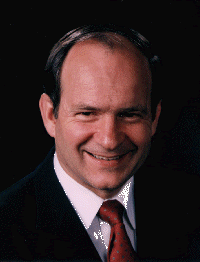
As Christians approach the end of this century, many groups within the worldwide body of Christ see the year 2000 as a symbolic milestone for humankind, says Luis Bush, International Director for the AD2000 & Beyond Movement. The AD2000 & Beyond Movement seeks to encourage cooperation in establishing a church within every unreached people group and making the gospel available to every person by the year 2000. Ralph Winter, founder of the U.S. Center for World Mission, calls the AD2000 & Beyond Movement the largest, most pervasive global evangelical network ever to exist. Patrick Johnstone, author of the book Operation World, writes, I believe that God has given us the best opportunity in all history to gain a wide level of support among Christians committed to world evangelization in the AD2000 vision.
Born in Argentina and raised in Brazil, Bush studied theology in Texas after three years in business accounting and systems work. Upon graduation from seminary, he and his wife Doris moved to El Salvador, where he pastored Iglesia Nazaret, a mushrooming mission-focused church in San Salvador. In the seven years in which he served as pastor, the church grew to almost 1300, and the congregation planted seven daughter churches and supported over 35 missionaries.
With his deep-seated zeal for world evangelization, Bush served as coordinator for COMIBAM (Congress on Missions for Ibero America) held in S? Paulo, Brazil, in 1987. The enthusiasm generated by the conference, attended by 3,000 Latin Americans with a total of 55 countries represented, stimulated church involvement and new mission agencies across the continent. The congress marked the emergence of Latin America as a full partner in world missions. Bush sees the trends in this decade centering upon the rapid internationalization of the mission force. There are over 50,000 non-Western missionaries and the number is growing at about 15 percent a year.
From 1986 to March 1992, Bush served as Chief Executive Officer of Partners International, which is associated with almost 70 indigenous ministries in 50 countries. During his tenure, the associated partner ministries established over 2,800 new churches, an average of more than one new church every single day; 78% of these in the 10/40 Window. Partnering in Ministry, which Bush co-authored with Lorry Lutz, describes the essential ingredients of mission partnerships and presents case studies of a variety of structures in mission organizations. Facilitating cooperative partnerships between mission agencies is a ministry of the AD2000 & Beyond Movement.
Bush pinpointed the need for a major focus of evangelism in the 10/40 Window, a phrase he coined in his presentation at the Lausanne II Conference in Manila, in July 1989, to describe the region between the 10th and 40th parallel north stretching from western Africa to eastern Asia. This concept led to Praying Through the Window in October 1993 with an approximate 20 million participants and A Day to Change the World on June 25 1994 involving an estimated 20 million intercessors. For Praying Through the 100 Gateway Cities of the 10/40 Window in October 1995 an estimated 200 million intercessors participated. Luis served as the Congress Director for the Global Consultation on World Evangelization (GCOWE) in May 1995 in Seoul, Korea where 4000 participants in the AD2000 & Beyond Movement from 186 countries.
In December 1995 Bush coordinated the Launch, a gathering of Christian leaders from 77 countries to launch the integrated AD 2000 & Beyond Movement five year plan with the primary focus on encouraging AD 2000 national initiatives in every country of the world and Joshua Project 2000, a global strategy to establish a church planting movement among each of the 2000 least evangelized peoples of the world.
He and his wife Doris have four children and live in Colorado Springs, Colorado.
5-9-95
Back to theAD2000 home page
는 10/40창에 관심을 가지고 선교해야되는 이유 7가지를 제시했다.
80년대 세계인구의 18%에 불과했던 이슬람인구는 2000년 23%, 2025년엔 31%를 차지, 기독인구를 능가할 전망이다. 헌팅턴 교수에 따르면 이로 인해 현재의 종교적 균형이 근본적으로 깨지면서 두 이질 종교문명간 갈등이 커지게 된다는 것. 이슬람인구의 증가는 중국 의 부흥과 함께 21세기 초반 정치적 불안정과 지역분쟁의 주원인으로 등장한다는 것이 그의 주장이다.
특히 산아제한을 거부하는 이슬람 정책은 인구급증의 내재적 요인이 되고 있다. 대부분 이슬람국가들이 94년 카이로 유엔인구개발회의에서 채택한 제3세계 인구제한안을 거부한 것이 한 예이다. 더구나 이슬람근본주의 세력들은 가능한 한 출산을 많이 해 이슬람을 전파하는 것이 자신들의 의무라고 믿고 있고, 필요하다면 이들을 성전의 전사로 내보내야 한다고 주장하고 있다.
흥미로운 사실은 이슬람교와 기독교의 충돌은 양 종교간 차이점이 아닌 유사함 때문이라는 것. 즉 둘 다 신앙의 전파를 목적으로 하기 때문에 마찰이 불가피하다는 것. 그는 이럴 경우 유교권인 일본을 비롯하여 러시아, 인도 등과 같이 어느 한쪽에도 속하지 않아 「균형추」 역할을 하는 문화가 어느 한쪽을 지원할 경우 종교간 충돌규모는 더욱 커지게 될 것이라고 전망했다.) 孫英玉, 국민일보 97.11.1 선교면
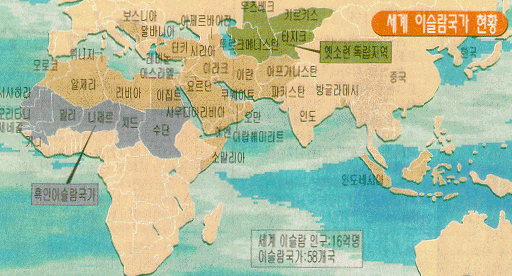
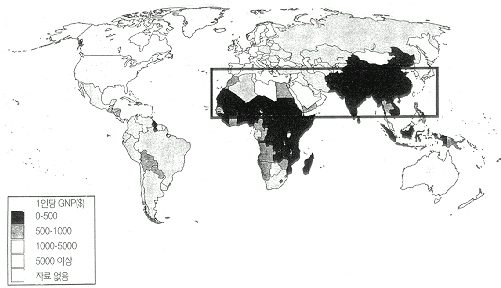

The term "10-40 Window" refers to the area of the world which lies between 10 degrees and 40 degrees north latitude from the equator, bounded by Africa to the west and Japan to the east. This includes all of parts of 61 countries in southern Europe, northern Africa, the entire Middle East, and much of southeast Asia.
This are of of the world is also often called "The Resistance Window" because it is difficult for Christians to bring the Word of God to the people who live there. The three major religions of the area -- Islam, Hinduism, and Buddhism -- are very militant. Governments in the "10-40 Window" restrict Christianity and Christian missionary activities in their countries.
The countries of the "10-40 Window" are very densely populated and extremely poor. In fact, the region's four billion people account for more than half of the world's population. They also make up 99 percent of the world's poorest people.
Low adult literacy rates, the extreme diversity of languages, and significant cultural differences (even within an individual country) make effective evangelism nearly impossible in the "10-40 Window." However, the major deterrent to traditional missionary efforts is the fanaticism and intolerance of the area's major religions.
The strong and often militant religions of the region... the vast cultural and language diversity of the peoples... the extreme poverty and illiteracy... these and other challenges represent tremendous obstacles for traditional mission outreach efforts within the "10-40 Window."
However, significant opportunities exist for the media ministry of Lutheran Hour Ministries (LHM). LHM uses radio, television, print, cassette ministry, and more to reach across tribal and national boundaries, spreading God's Word.
A network of LHM offices are now carrying on effective outreach in Ghana, Lebanon, India, Hong Kong, Thailand, Japan, Nigeria, and the Philippines. These offices work in the language and cultural patterns of the countries in the "10-40 Window." They also bridge into neighboring countries, especially in the Middle East.
In addition, LHM project centers are gearing up in such countries as Egypt, Jordan, Morocco, Ethiopia, and china. These centers use the same appropriate language and cultural approaches to effectively communicate the light of God's Word to the hundreds of millions of people living in darkness within the "10-40 Window." Strategic plans include identifying additional project center sites for future development.
For the people of the "10-40 Window" there is an unbreakable link between one's religion, one's ethnic and national identity, and one's cultural ties to family and neighbors. These bonds are so strong that those who convert to Christianity are often shunned by members of their community and family, and they are often arrested, tortured or killed for this "betrayal" to their religions.
The countries of the "10-40 Window" are dominated by three major religions, each of which is very militant. A quick review of each of thes religions will shiow why it is so difficult for Christians to bring the Word of God to the more than four billion people living in the area.
Hinduism
Approximately 717 million people in the "10-40 Window" are Hindus. Although Hinduism is the third largest religion in the entire world, it is the most prominent religion in the region, accounting for 23 percent of the total population of the area.
Hindus believe in reincarnation, and that one's soul returns to earth in the body of another person or animal following death. The person is believed to belong to one of five social castes, or classes. The person's goal is to practice discipline on earth in order to advance to the next highest leve. Hindus believe that this cycle of rebirth, called "moksha," continues until the sould receives salvation (known as total enlightenment). Hindus believe that "all of reality is one." That is, both the meaning of the world and the way to reach salvation is through cognition, or knowledge.
Islam
The followers of Islam are known as Muslims. Islam is the second largest religion in the world, second only to Christianity. It is also the second most prevalent religion in the "10-40 Window" countries, with nearly 706 million followers. Muslims believe in one god, who name is Allah. The founder of their religion, Muhammad, is their god's only true prophet.
Muslims believe they must earn salvation by faithfully fulfilling the five basic demands of their religion: the daily recital of a sacred oath; recitation of prescribed prayers five times a day; fasting; giving alms to the poor, and making a pligrimage to Mecca, one of the two holy cities of their religion.
There are two major groups, or sects, within the Muslim religion. The Shi'ites, which are about 10% of all Muslims, are the most visible and vocal. They believe in strict enforcement of Muslim law, and are under the spritual and governmental leadership of the Ayatolla. The second sect, the Sunnites, are much more tolerant of diversity, and believe that the Muslim faith can be lived out within the context of existing governments.
Buddhism
The nearly 153 million Buddhists in the "10-40 Window"do not believe in a god. Nor do they pray, make sacrifices, or believe in an afterlife. Buddhism has been called "the religion of practical atheism." Like Hinduism, Buddhism expounds a believ in reincarnation, with salvation as the ultimate escape from the cycle of rebirth. Unlike Hinduism, however, Buddhism does not have a caste system.
Buddhism believes that ignorance is the root of all evil, and that the only way to destroy ignorance is to follow the four noble truths of their religion: suffering is universal; suffering is caused by desire; desire must be eliminated, and the only way to eliminate desire is to follow eight steps of dailing living. These steps, known as the "eightfold path," are: right belief; right feelings; fight speech; right conduct; right livelihood; right effort; right memory, and right meditation.
Significant opportunities exist for the media ministry of Lutheran Hour Ministries. We use radio, television, print, cassettes and more to reach across tribal and national boundaries, to let the light of the Gospel shine brightly into the "10-40 Window."
A network of LHM offices are now carrying on effective outreach in Ghana, Lebanon, India, Hong Kong, Thailand, Japan, Nigeria, and the Philippines. These offices work in the language and cultural patterns of the countries in the "10-40 Window." They also bridge into neighboring countries, especially in the Middle East.
In addition, LHM project centers are gearing up in such countries as Egypt, Jordan, Morocco, Ethiopia, and china. These centers use the same appropriate language and cultural approaches to effectively communicate the light of God's Word to the hundreds of millions of people living in darkness within the "10-40 Window." Strategic plans include identifying additional project center sites for future development.)

